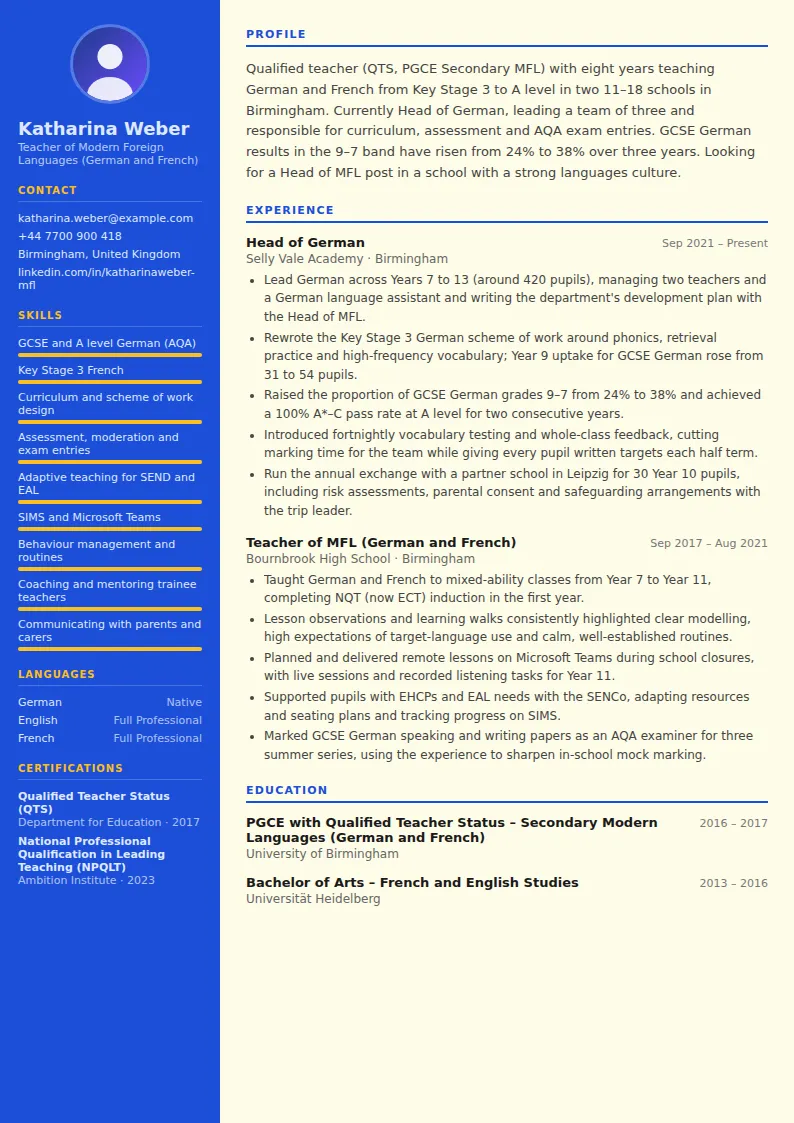
Put qualified status and safeguarding where they are seen
The first check any school makes is whether you can be employed as a teacher. Name your qualification and status clearly, in your summary and in your education section:
- England: QTS, and whether you have completed ECT induction. Teachers trained elsewhere often hold QTS through the international route, so say when it was awarded.
- Scotland: full registration with the GTCS.
- Ireland: registration with the Teaching Council, your subject and Droichead status.
- International schools: your home teaching licence plus any IB or Cambridge training.
Safeguarding matters just as much. Note your most recent safeguarding training and any designated safeguarding lead (DSL) or deputy role. Account for every gap in your employment history with a short line, such as a career break or travel, because safer recruitment checks will ask about it anyway.
How to write a teacher CV summary
In three or four sentences, cover your qualified status, your subject or phase, the age range or key stages you teach, your current responsibility, and the post you want next. Then add one concrete result. For secondary teachers, that is usually exam outcomes or uptake. For primary teachers, it might be phonics screening, reading progress or a subject you lead across the school.
Leave out lines like passionate about inspiring young minds. Every applicant will claim it. Instead, show it through what you have done, for example a club you started, a trip you run every year, or pupils who chose your subject at GCSE.
What to put in your experience section
Begin each post with the context: the type of school (primary, 11–16, 11–18, special school, international), the subjects and key stages you taught, and any responsibility you held (TLR, head of year, subject lead). Then pick three to five bullets that show impact:
- Outcomes: exam results, value added or progress against targets, reading ages, uptake at GCSE or A level. Compare with a previous year or the school's figures rather than claiming national comparisons.
- Curriculum: schemes of work you wrote, assessment you redesigned, new courses or exam boards you introduced.
- Inclusion: how you adapt for pupils with SEND or EAL, and your work with the SENCo and teaching assistants.
- Leadership and the wider school: mentoring trainees and ECTs, running trips, clubs, revision programmes or pastoral roles.
When you describe lesson observations, focus on the feedback you received rather than a grade. Many schools no longer grade single lessons, so a line such as observations highlighted clear modelling and strong routines reads as more credible.
Skills, CPD and professional development
Use your skills section for things a head of department can rely on from day one: the exam specifications you have taught (for example AQA GCSE Biology or Edexcel A level History), the systems you use (SIMS, Arbor, Bromcom, Google Classroom, Microsoft Teams), and classroom strengths such as behaviour management, adaptive teaching or retrieval practice.
List CPD that changed your practice or led to a qualification, such as an NPQ, a master's module, examiner training or a subject knowledge course, rather than every INSET day. Being an exam board examiner or moderator is worth a line of its own, because it shows you understand the mark scheme from the inside.
Length, format and tailoring to the school
Keep your teacher CV to two pages, in reverse chronological order, with clear headings. Trainee and early career teachers can fit onto one page. Put your teaching practice placements under experience, with the school, the key stages and what you taught.
Tailor the CV to each school. Read the job description, the person specification and the school's website, then reflect what matters to them: a trust-wide curriculum, a focus on reading, a growing sixth form or an inclusive SEND provision. Many state schools ask for an application form and a supporting statement as well as, or instead of, a CV.
Teacher CV summary examples
Experienced
Assistant Headteacher with QTS and 15 years' experience in secondary schools, currently leading teaching and learning and the ECT programme across an 1,100-pupil 11–18 academy. History specialist teaching to A level. Holds the NPQ in Senior Leadership and is a trained DSL. Seeking a Deputy Headteacher role focused on curriculum and staff development.
Mid-level
Primary teacher with QTS and six years in Key Stage 2, currently teaching Year 6 and leading maths across a two-form-entry primary school. Introduced a mastery approach and daily fluency sessions that raised the proportion of pupils meeting the expected standard in maths from 68% to 81%. Looking for a Year 6 or phase lead post.
Entry-level
PGCE Secondary Chemistry trainee on track for QTS, with placements in an 11–16 comprehensive and an 11–18 academy teaching Key Stages 3 and 4. Confident in practical science, CLEAPSS safety procedures and teaching combined science to mixed-ability classes. Looking for an ECT post with a strong induction and mentoring programme.
Teacher CV bullet point examples
- Raised the proportion of GCSE English Language grades 5 and above from 52% to 64% across three Year 11 classes through weekly timed writing and targeted intervention groups.
- Rewrote the Key Stage 3 geography curriculum around fieldwork and disciplinary knowledge, which led to 18 more pupils choosing GCSE Geography the following year.
- Led phonics across Reception and Year 1; the Year 1 phonics screening pass rate rose from 74% to 88% in two years.
- Mentored 4 PGCE trainees and 3 ECTs as subject mentor, with all trainees recommended for QTS and both ECTs completing induction.
- Planned and led a residential Year 8 science trip for 60 pupils, managing risk assessments, staffing ratios and medical plans with the Educational Visits Coordinator.
- Worked with the SENCo to adapt resources and assessments for 9 pupils with EHCPs, with each pupil meeting their annual review targets in maths.
- Introduced a whole-department behaviour routine for starts and ends of lessons, cutting behaviour points logged on Arbor by a third in one term.
- Ran Saturday revision sessions and a lunchtime A level clinic for 40 Year 13 pupils; the department's A level results improved by half a grade on average.
- Served as deputy DSL, recording concerns on CPOMS, attending strategy meetings and delivering annual safeguarding refresher training to 35 support staff.
- Marked GCSE papers as an examiner for two exam series and used it to train the department on applying the mark scheme in mocks.
Skills for your Teacher CV
Hard skills
- Subject knowledge to GCSE or A level (state your subjects)
- Curriculum and scheme of work planning
- Formative and summative assessment
- Exam specifications and mark schemes (AQA, Edexcel, OCR)
- Adaptive teaching for SEND and EAL
- Phonics and early reading (primary)
- Behaviour management systems
- Data tracking with SIMS, Arbor or Bromcom
- Safeguarding and recording concerns (e.g. CPOMS)
- Google Classroom or Microsoft Teams for learning
- Educational visits planning and risk assessment
- Exam marking or moderation
Soft skills
- Calm, consistent classroom presence
- Clear explanation and modelling
- Building relationships with pupils
- Communicating with parents and carers
- Mentoring trainees and ECTs
- Working with teaching assistants and the SENCo
- Resilience during busy assessment periods