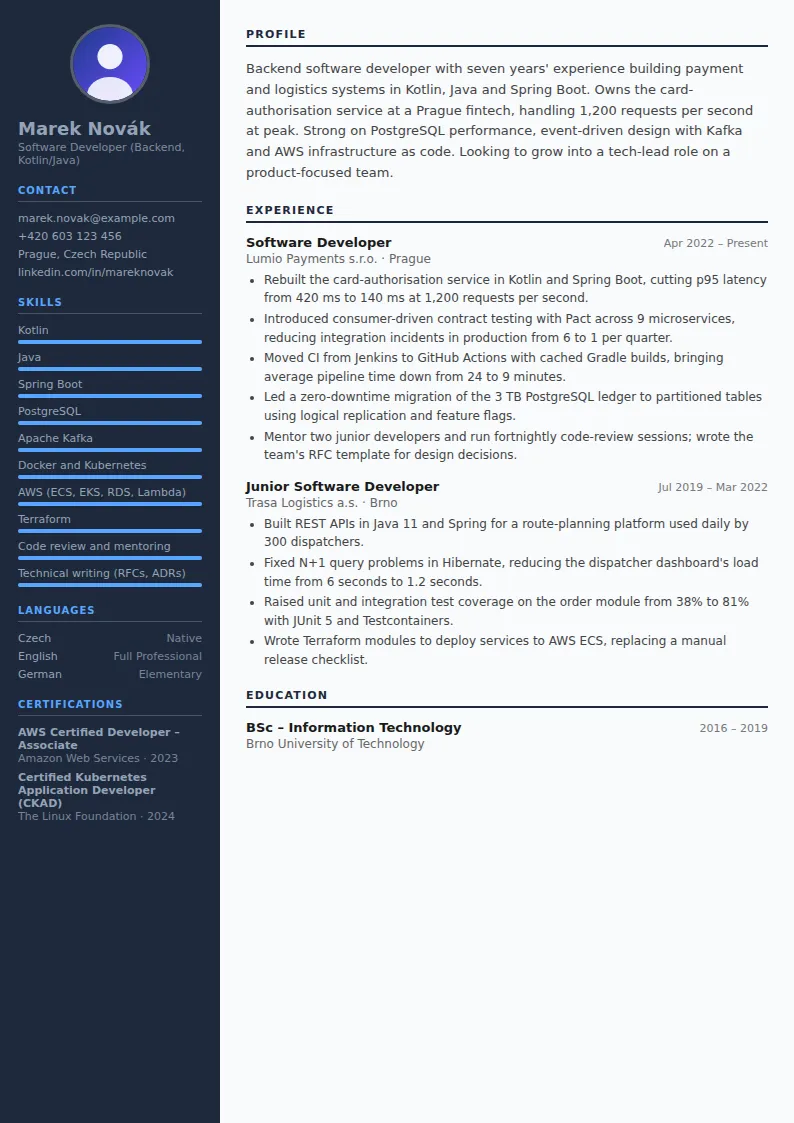
How to write a software developer CV summary
Your summary should answer three questions in three or four sentences: what you build, with which stack, and at what scale or in which domain. 'Backend developer with seven years in Kotlin and Spring Boot, building payment services that handle 1,200 requests per second' tells a tech lead more than any list of adjectives.
- Lead with your specialism: backend, frontend, full-stack, mobile, embedded or platform. Recruiters filter on it before anything else.
- Name your core stack once: two or three languages and your main framework. The full list belongs in the skills section.
- Add one proof point: a migration you led, a latency or cost reduction, or a product you shipped.
- Cut the clichés: 'passionate about clean code' and 'fast learner' give a reviewer nothing to check.
Writing experience bullets engineers believe
Engineering managers read your bullets looking for ownership and judgement, not a list of tickets. 'Worked on microservices' could describe anyone on the team; 'Split billing out of the monolith into two Spring Boot services, cutting deploy time from 40 to 8 minutes' shows what you decided and what changed.
- Start with a verb that shows your part: designed, migrated, rewrote, profiled, automated, led.
- Quantify with engineering metrics: p95 latency, throughput, error rate, uptime, build time, deploy frequency, cloud spend, test coverage.
- Give scale: users, requests per second, data volume, number of services or engineers involved.
- Name the technology inside the bullet when it matters, so a reviewer sees where you actually used Kafka or Terraform rather than just that you list them.
- Include at least one bullet on how you work with others: code review, mentoring, incident response, writing RFCs.
If an NDA stops you sharing exact figures, use relative ones ('roughly halved build time') or describe the scale without naming the client.
GitHub, portfolio and open-source links
Put your GitHub or GitLab URL in the header next to LinkedIn, but only if it helps you. Reviewers who click through look at your pinned repositories, the READMEs and whether the commit history looks like real, incremental work.
- Pin three to six repositories that match the jobs you want. A backend applicant gains more from one well-tested API with a Dockerfile and a CI pipeline than from ten tutorial clones.
- Give each a README: what it does, how to run it, the architecture decisions and what you would change next.
- If you contribute to open source, link specific merged pull requests. They show you can work in someone else's codebase and respond to review.
- If nearly all your work is in private repositories, leave the link out rather than sending people to an empty profile, and describe your design decisions in your bullets instead.
Frontend and mobile developers should add a live demo or an app store link; a working product gets looked at faster than source code.
How to list your tech stack
A wall of 40 logos or skill bars makes it hard to see what you really know. Group your skills so a reader can scan them in seconds:
- Languages: Kotlin, Java, TypeScript, Python
- Frameworks: Spring Boot, React, Node.js
- Data: PostgreSQL, Redis, Kafka
- Cloud and infrastructure: AWS, Docker, Kubernetes, Terraform
- Practices: TDD, CI/CD, observability, trunk-based development
Only list what you would be comfortable being questioned on in a technical interview. Applicant tracking systems match terms literally, so mirror the job ad: if it says 'PostgreSQL', don't write only 'Postgres'; if it asks for '.NET 8', say which .NET versions you have shipped with.
Length, format and tailoring
Keep your CV to one page with under three years' experience and two pages at most after that. Use reverse chronological order, a single-column layout and plain section headings so ATS parsers read it correctly. Drop technologies you last touched a decade ago; nobody hiring for a React role needs your old jQuery plugins.
Tailor each application by reordering skills and bullets to match the ad. For a platform or DevOps role, move your CI/CD, Kubernetes and Terraform work to the top of each job. For a product engineering role, lead with features you shipped and the users they reached. In the UK and Ireland, leave out your photo and date of birth; elsewhere in Europe, follow the norms of the employer's country.
Software Developer CV summary examples
Experienced
Senior backend engineer with eleven years building distributed systems in Java, Kotlin and Go. Led the move of a payments platform from a monolith to 20 services on Kubernetes, taking releases from monthly to daily. Experienced in system design, running on-call rotations and mentoring a team of six. Looking for a staff or tech-lead role in fintech or infrastructure.
Mid-level
Full-stack developer with four years' experience in TypeScript, React and Node.js, building B2B SaaS used by 15,000 weekly active users. Owns features end to end, from PostgreSQL schema design to accessible front-end components and Cypress tests. Recently rebuilt the reporting module, cutting page load from 5 seconds to under 1.
Entry-level
Computer science graduate from University College Dublin with a six-month internship on a Python and Django team. Built and deployed a booking API with FastAPI, PostgreSQL and GitHub Actions, now handling 300 weekly bookings for a local sports club. Comfortable with Git workflows, code review and writing tests; looking to join a backend team as a junior developer.
Software Developer CV bullet point examples
- Cut p95 API latency from 850 ms to 210 ms by adding Redis caching and rewriting three N+1 Hibernate queries.
- Migrated 14 services from EC2 to Amazon EKS with Helm charts, reducing monthly AWS spend by €9,000.
- Introduced feature flags and trunk-based development, moving the team from fortnightly to daily releases and cutting rollback time to minutes.
- Built an event-driven order pipeline on Kafka with idempotent consumers, processing 2 million messages a day without duplicate orders.
- Raised test coverage on the checkout service from 45% to 85%, halving defects that reached production over the next two releases.
- Rewrote the React dashboard with code splitting and memoisation, improving Largest Contentful Paint from 4.1 s to 1.6 s.
- Designed the public REST API and its OpenAPI documentation, now used by 40 partner integrations.
- Led the post-incident review of a three-hour outage and shipped circuit breakers and alerting that prevented a repeat over the following year.
- Automated database migrations with Flyway in the CI pipeline, removing manual release steps for a team of eight.
- Mentored three junior developers through their first production releases; two were promoted to mid-level within 18 months.
Skills for your Software Developer CV
Hard skills
- Java or Kotlin
- TypeScript and JavaScript
- Python
- Spring Boot
- React
- Node.js
- SQL and PostgreSQL
- REST and GraphQL API design
- Docker and Kubernetes
- AWS, Azure or Google Cloud
- CI/CD pipelines (GitHub Actions, GitLab CI)
- Automated testing (JUnit, Jest, Cypress)
Soft skills
- Giving and receiving code review
- Technical writing (RFCs, ADRs, documentation)
- Mentoring junior developers
- Calm debugging during incidents
- Breaking down and estimating work
- Working with product managers and designers
- Explaining trade-offs to non-technical stakeholders