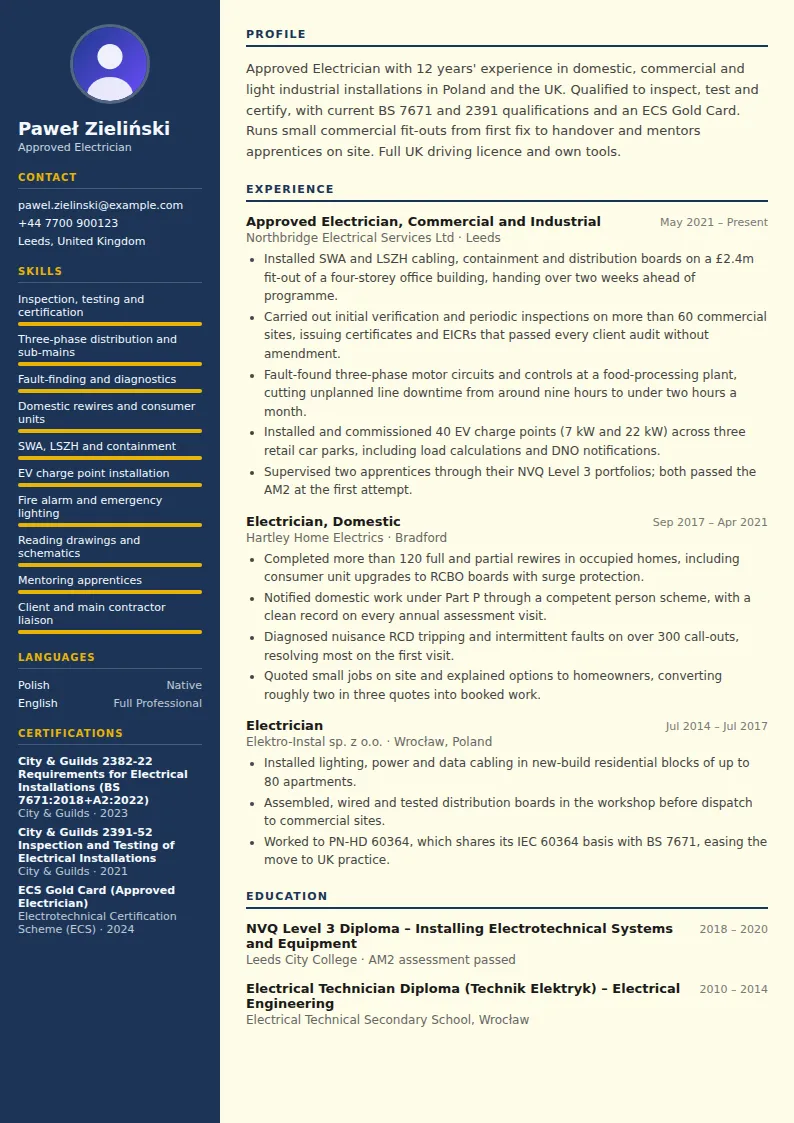
How to write an electrician CV summary
Your summary is three or four lines that answer the questions a contracts manager has before picking up the phone. Lead with your status and years in the trade (for example “Approved Electrician with eight years' experience” or “NVQ Level 3 qualified electrician”), then the type of work you do and the installations you know best.
- Status and level: apprentice, improver, qualified or approved electrician, plus any recognised card or registration, such as an ECS card in the UK or registration with your national electrical safety body.
- Sector: domestic rewires and consumer units, commercial fit-outs, industrial maintenance, or a mix. If you want to move from one to another, say so.
- Specialisms: inspection and testing, fire alarm and emergency lighting, EV charging, solar PV and battery storage, data cabling, motor control.
- One proof point: a project size, a testing record or a responsibility such as running jobs or apprentices.
“Full driving licence and own tools” tells an employer more than “hard-working and reliable”, and most van-based jobs require it.
Qualifications and certificates: what to list and how
For electricians, qualifications are not a formality at the bottom of the page. Employers screen on them, so give them a clearly labelled section and use the exact names on your certificates, with the year you passed.
- Your core trade qualification: whatever makes you a qualified electrician in your country, with the level. In the UK that is usually an NVQ Level 3 plus the AM2 assessment; elsewhere it may be a national vocational diploma or a master craftsperson qualification.
- Wiring regulations: show you are current with your country's wiring regulations and name the edition. In the UK that means the BS 7671 18th Edition qualification (City & Guilds 2382), updated when a new amendment is published.
- Inspection and testing: a separate qualification such as City & Guilds 2391 opens up testing and certification work, so give it its own line.
- Specialist and site tickets: EV charger installation, solar PV, fire alarm systems, IPAF or PASMA, your site safety card, and first aid.
If you trained in one country and work in another, list the original qualification with a short English description and note any recognition or top-up training you have completed. Employers rarely know foreign qualification names, and one line of explanation saves them guessing.
What to put in your experience section
For each employer, give your job title, dates and whether the work was domestic, commercial or industrial. Then add three to five bullets about what you installed, tested or maintained, at what scale and with what result.
- Name the installations: distribution boards, three-phase supplies, SWA, containment, fire alarm and emergency lighting, EV charge points, PV arrays, motor starters and control panels.
- Give scale: number of rewires, floor area, number of points or circuits, contract value, or how many sites you covered.
- Show quality: inspection results, no remedial items at handover, a clean record on scheme assessments, no call-backs.
- Show responsibility: running jobs on your own, supervising apprentices or improvers, dealing with clients and main contractors, ordering materials.
Fault-finding is one of the most valued skills on maintenance and call-out work, so include at least one example of a fault you traced and how quickly the system was back in service.
Skills that matter to electrical employers
Be precise about technical skills. “Testing” is vague; “insulation resistance, earth fault loop impedance and RCD testing with a multifunction tester” shows you can do the job. Name the systems you have worked on: single-phase domestic, three-phase commercial, industrial controls.
Working skills should reflect site reality rather than generic soft skills: reading drawings and schematics, safe isolation and permit-to-work procedures, explaining options and costs to homeowners, and coordinating with other trades on a tight programme.
Tailoring your CV and keeping it to two pages
A domestic contractor, a facilities maintenance company and an industrial installer want different things from the same trade. Before you apply, check the ad for the type of work, the qualifications it asks for and extras such as a driving licence, an on-call rota or experience with a particular system, then move the matching evidence into your summary and first job.
Two pages are enough for most electricians. Compress unrelated early jobs into a single line and keep your qualifications on the first page when they are mandatory for the role.
Electrician CV summary examples
Experienced
Approved Electrician with 15 years in commercial fit-outs and industrial maintenance, qualified to inspect, test and certify. Has run teams of up to six on office and warehouse projects worth up to £3m, working closely with main contractors and clients through to handover. Current wiring regulations and inspection and testing qualifications. Looking for a supervisor or contracts lead role.
Mid-level
NVQ Level 3 qualified electrician with five years in domestic and light commercial work, including full rewires, consumer unit replacements and EV charger installations. Comfortable working alone, completing certification paperwork and explaining options to customers. Full driving licence and own tools; keen to move into inspection and testing.
Entry-level
Newly qualified electrician who has completed a four-year apprenticeship and the final practical assessment, with experience in new-build housing, small commercial fit-outs and fault-finding on call-outs. Up to date with the current edition of the wiring regulations. Seeking a role with a commercial contractor to broaden experience and work towards an inspection and testing qualification.
Electrician CV bullet point examples
- Installed lighting, power and containment for a 3,200 m² warehouse fit-out, finishing first fix five days ahead of the main contractor's programme.
- Completed 85 domestic rewires and consumer unit upgrades to RCBO boards, with no call-backs during the 12-month warranty period.
- Carried out periodic inspections on 40 rented properties for a letting agent, rectifying all C2 defects within the agreed 28 days.
- Traced a recurring earth fault on a packaging line's control circuit, restoring production within three hours of the call-out.
- Installed and commissioned 24 EV charge points at a hotel car park, using load management to avoid an expensive supply upgrade.
- Wired and tested the fire alarm and emergency lighting in a 60-bed care home, passing the fire officer's inspection first time.
- Supervised two apprentices on site daily and signed off their work logs; both completed their qualifications on schedule.
- Replaced obsolete three-phase distribution in a secondary school within the six-week summer shutdown.
- Produced as-fitted drawings and test results for every circuit on a 120-unit apartment block, accepted by the client without amendments.
Skills for your Electrician CV
Hard skills
- Domestic, commercial and industrial installation
- Three-phase distribution and sub-mains
- Inspection, testing and certification
- Fault-finding and diagnostics
- Consumer unit and distribution board replacement
- SWA, LSZH and containment installation
- Fire alarm and emergency lighting systems
- EV charge point installation
- Solar PV and battery storage
- Reading drawings, schematics and wiring diagrams
- Motor control and starters
- Safe isolation and permit-to-work procedures
Soft skills
- Working unsupervised on site
- Explaining options clearly to homeowners and clients
- Coordinating with other trades
- Mentoring apprentices and improvers
- Planning work to a fixed programme
- Attention to safety and detail
- Calm, methodical problem-solving