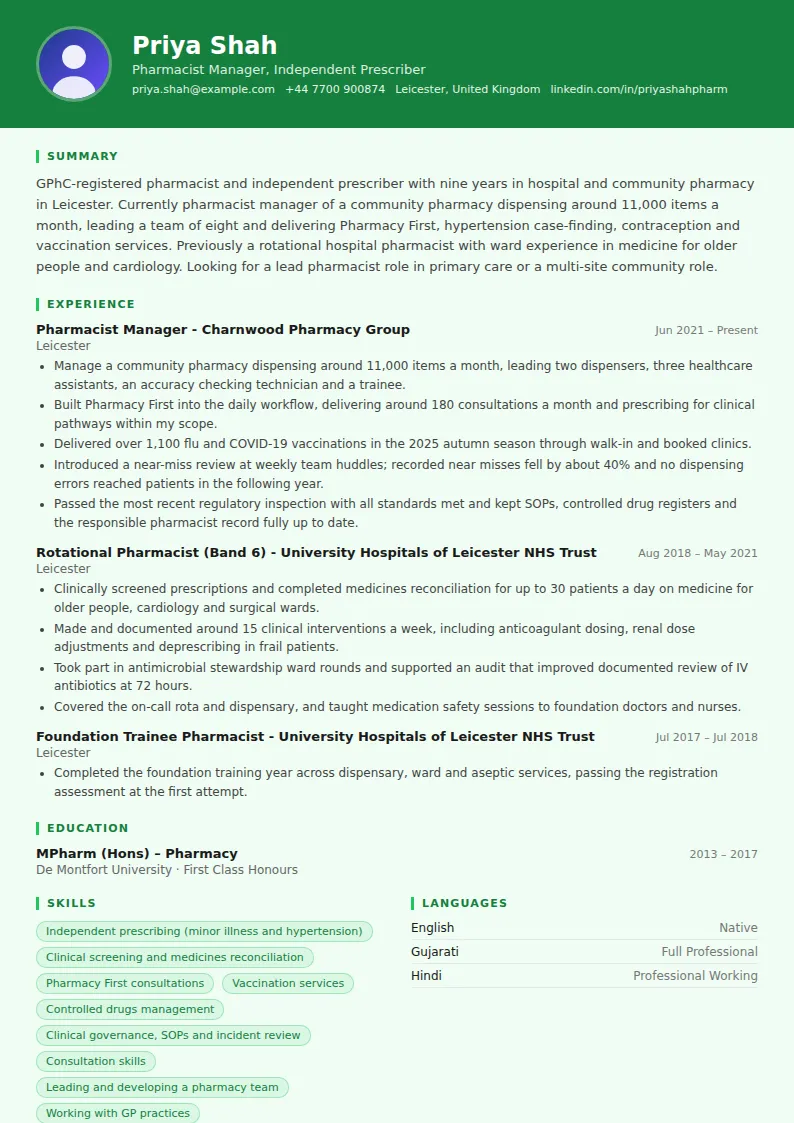
Show your registration and prescribing status first
Every pharmacy employer needs to know you can practise. Put your registration in your summary or under your name: the regulator and any annotations, such as GPhC-registered pharmacist, independent prescriber in Great Britain or registered with the PSI in Ireland. You don't need to include the registration number itself; employers check it on the public register.
- Prescribing: if you are an independent prescriber, give your scope of practice, such as minor illness, hypertension, respiratory or diabetes.
- Moving countries: state where you are in the registration process, including any adaptation period, assessment or language test you have passed.
- Newly qualified: state that your registration is confirmed or when you expect it, and where you completed your foundation year.
How to write a pharmacist CV summary
Your summary should cover four things in three or four sentences: your registration and prescribing status, your sector and years of experience, your level (pharmacist, manager, specialist, lead), and the clinical areas or services you know best. End with the role you want next.
Instead of general claims like dedicated pharmacist with strong clinical knowledge, use specifics: delivers around 180 Pharmacy First consultations a month or specialist pharmacist in cardiology with an independent prescribing clinic. If you are moving between sectors, such as from hospital to primary care, say so and point to the experience that carries over.
Experience: services, clinical work and safety
For each role, give the setting and scale first: items dispensed per month in community, ward types and bed numbers in hospital, practice list size in primary care. Then choose bullets from these areas:
- Clinical services: consultations, vaccinations, minor illness and pathway services, new medicine and medication review services, prescribing clinics.
- Clinical interventions: medicines reconciliation, dose adjustments, deprescribing, anticoagulation, antimicrobial stewardship.
- Safety and governance: near-miss and error reduction, audits, SOPs, controlled drugs management, inspection outcomes.
- Team and business: staff managed, training of dispensers and technicians, service growth, stock and workflow improvements.
- Teaching: trainee pharmacists, foundation doctors, nurses or students you have supported.
Use numbers from your service records, audits or dispensing reports, and keep patient details out of your examples.
Skills, training and CPD
Split skills into clinical and professional. Clinical skills should be specific: clinical screening, medicines reconciliation, prescribing in named areas, vaccinations, therapeutic drug monitoring, aseptic or oncology work, and the dispensing and patient record systems you use. Professional skills include consultation skills, team leadership, clinical governance and working with GP practices and hospital teams.
List postgraduate qualifications such as a clinical pharmacy diploma or independent prescribing certificate with the institution and year. You don't need to list every CPD module; choose the training relevant to the job, such as clinical examination skills, vaccination training or a specialist course, and add one line that your revalidation or CPD is up to date.
Length, format and tailoring by sector
Two pages suit most pharmacists. Newly qualified pharmacists can use one page, describing their foundation year rotations and placements in detail. Use reverse chronological order and clear headings, because many NHS and large employers use online forms or applicant tracking systems.
Tailor your CV to each sector. Community employers want services, team management and dispensing safety. Hospital roles want clinical specialities, ward experience and interventions. Primary care roles want prescribing, structured medication reviews and work with GP practices. Industry and regulatory roles want quality systems, documentation and knowledge of the relevant regulations.
Pharmacist CV summary examples
Experienced
Lead pharmacist and independent prescriber with 14 years in hospital and primary care, currently leading a team of nine clinical pharmacists and technicians across a primary care network of 70,000 patients. Runs structured medication review and polypharmacy programmes with measurable reductions in high-risk prescribing. Looking for a head of medicines optimisation role.
Mid-level
Hospital pharmacist with five years in acute medicine and surgery, completing medicines reconciliation and clinical screening for up to 35 patients a day. Holds a postgraduate diploma in clinical pharmacy and contributes to antimicrobial stewardship rounds. Looking for a specialist pharmacist post in critical care or cardiology.
Entry-level
Newly registered pharmacist who completed a foundation training year split between a community pharmacy and a hospital trust, covering dispensing, clinical screening, vaccinations and minor illness consultations. Passed the registration assessment at the first attempt. Looking for a community or rotational hospital pharmacist post.
Pharmacist CV bullet point examples
- Managed a community pharmacy dispensing around 10,000 items a month with a team of seven, meeting all standards at the last regulatory inspection.
- Delivered around 150 minor illness consultations a month, prescribing within my scope and referring to GPs where needed.
- Ran a hypertension case-finding service that identified 64 patients with previously undiagnosed high blood pressure in one year, all referred for review.
- Reduced near-miss dispensing errors by 40% through weekly team reviews and changes to shelf layout for look-alike, sound-alike medicines.
- Completed medicines reconciliation for up to 30 patients a day on acute medical wards, documenting around 15 clinical interventions a week.
- Led a deprescribing project in care homes that reduced anticholinergic burden for 45 residents.
- Administered over 1,000 seasonal vaccinations in one autumn through walk-in and booked clinics.
- Supervised two trainee pharmacists through their foundation year, both passing the registration assessment first time.
- Rewrote 22 standard operating procedures and trained staff on them ahead of a change of ownership.
Skills for your Pharmacist CV
Hard skills
- Clinical screening of prescriptions
- Medicines reconciliation
- Independent prescribing
- Minor illness and pathway consultations
- Vaccination and injection technique
- Structured medication reviews
- Antimicrobial stewardship
- Anticoagulation monitoring
- Controlled drugs management
- Accuracy checking and dispensing systems
- Clinical audit and governance
- Patient medication records
Soft skills
- Consultation and counselling skills
- Clear explanations for patients
- Leading pharmacy teams
- Working with GPs and nurses
- Calm decision-making under pressure
- Teaching and supervising trainees
- Attention to detail