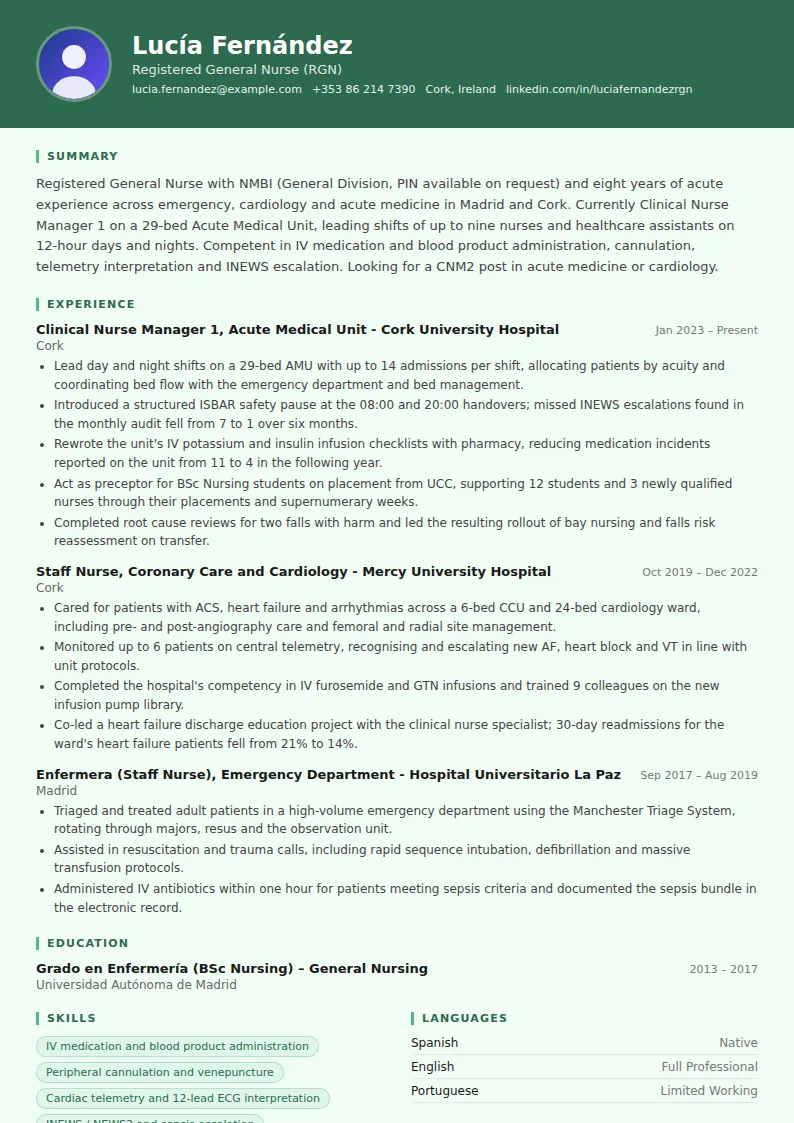
Show your registration first
Before anything else, a nurse recruiter needs to know you can legally practise. State your registration in your summary or directly under your name: the regulator, the part of the register or division, and whether you hold an active PIN. For example: NMC Registered Nurse (Adult), PIN available on request in the UK, or NMBI General Division in Ireland.
If you are moving countries, say exactly where your application is. Give recruiters a timeline:
- Registered: regulator, division and year of first registration.
- In progress: e.g. NMBI application submitted, decision letter expected March, plus any English test you have passed (IELTS Academic or OET) and the grades.
- Revalidation: in the UK, mentioning your next revalidation date shows your registration is current and your CPD is up to date.
How to write a nurse CV summary
Your summary should answer four questions in three or four sentences: your registration, your clinical area and years of experience, the level you work at (staff nurse, senior staff nurse, Band 6, CNM1), and the job you want next. Add one or two competencies that matter for the post you are applying for, such as telemetry, chemotherapy administration, tracheostomy care or theatre scrub and recovery.
Leave out lines like caring and compassionate nurse. Every nurse applying will say it. Show compassion through what you have done instead, for example leading end-of-life care planning, or setting up a dementia-friendly bay.
What to put in your experience section
Each role should give the reader the context of the ward before your achievements. Start with the speciality, the number of beds and the type of unit (acute admissions, step-down, day surgery, community caseload), and your shift pattern if it shows breadth, such as rotating 12-hour days and nights. A ward manager reading 32-bed acute stroke unit, 1:7 ratio on days immediately understands the workload you are used to.
Then choose three to five bullets that go beyond your job description:
- Patient safety: falls, pressure ulcers, medication incidents, missed escalations, and what changed because of you.
- Clinical skills and competencies: the extended skills you were signed off for and now teach others.
- Leadership: taking charge of the shift, managing bed flow, supervising healthcare assistants and agency staff.
- Teaching: preceptorship, practice supervision or assessment of students, induction of new starters.
- Quality improvement: audits, link nurse roles (infection control, tissue viability, diabetes) and projects you contributed to.
Use numbers only when you have them from audits, ward dashboards or incident reports. A real reduction in falls on your unit is far more convincing than a vague claim about improved care.
Skills, life support and mandatory training
Split your skills into clinical competencies and the way you work. Clinical skills should be specific: IV cannulation, NEWS2 escalation, PICC and central line care are better than clinical skills. Match them to the wording in the job advert where you honestly can.
List life support certificates with the issuing body and date, because recruiters check they are in date: BLS, ILS or ALS from the Resuscitation Council UK, or BLS and ACLS from the Irish Heart Foundation. Routine mandatory training such as manual handling, fire safety and hand hygiene does not need its own lines. A single line saying your mandatory training is up to date is enough.
Length, format and tailoring to the post
Two pages is right for most registered nurses. Newly qualified nurses can fit onto one page if it is mostly placements. Use reverse chronological order, clear headings and a plain, readable layout, since many trusts and health services upload CVs into an applicant tracking system or an online application form.
Before each application, read the person specification and mirror its essential criteria. If it asks for experience of caring for patients with tracheostomies, make sure that phrase, or your genuine equivalent, appears in your experience. If you are applying across specialities, for example from surgery to community nursing, lead with transferable skills like wound care, discharge planning and independent decision-making.
Nurse CV summary examples
Experienced
NMC Registered Nurse (Adult) with 12 years in critical care, including five as Band 7 Sister on a 16-bed general ICU. Lead a team of 60 nurses, manage the unit's off-duty and budget, and chair the monthly morbidity and safety meeting. Practice assessor and ALS instructor. Seeking a Matron post in critical care or surgery.
Mid-level
NMBI-registered General Nurse with five years on a busy surgical ward covering colorectal, upper GI and emergency general surgery. Regularly in charge of the shift, competent in PCA and epidural monitoring, stoma care and post-operative escalation. Link nurse for tissue viability. Looking to develop as a CNM1 in surgical care.
Entry-level
Newly qualified Registered Nurse (Adult), NMC registration confirmed, with final-placement experience on an acute medical ward and a community district nursing team. Signed off for medication administration, venepuncture and NEWS2 escalation. Looking for a preceptorship post on a medical or elderly care ward with structured rotation.
Nurse CV bullet point examples
- Took charge of a 28-bed elderly care ward on four shifts a week, allocating patients by acuity and coordinating 6 to 8 discharges a day with the discharge team and social workers.
- Reduced hospital-acquired pressure ulcers on the ward from 9 to 2 a year by introducing SSKIN bundle checks at every two-hourly intentional rounding.
- Led the ward's sepsis audit; patients receiving IV antibiotics within one hour of red-flag sepsis rose from 62% to 91% over eight months.
- Supervised and assessed 15 nursing students and 4 trainee nursing associates as practice assessor, with all students completing their placements on time.
- Administered chemotherapy and immunotherapy to 10 to 14 day-case patients per shift, following SACT safety checks and managing infusion reactions.
- Trained 22 colleagues on the new electronic prescribing and medicines administration system ahead of go-live, with no ward-level missed doses reported in the first month.
- Managed a caseload of 35 community patients with complex wounds, leg ulcers and palliative care needs, working with GPs and the hospice team to avoid admissions.
- Acted as infection prevention link nurse during a norovirus outbreak, managing cohorting and bay closures so the ward reopened in nine days.
Skills for your Nurse CV
Hard skills
- IV medication administration
- Peripheral cannulation and venepuncture
- NEWS2 / INEWS early warning escalation
- Sepsis recognition and management
- 12-lead ECG recording and telemetry monitoring
- Blood transfusion administration
- Wound assessment and dressing selection
- Catheterisation and continence care
- Central line and PICC care
- Tracheostomy and airway care
- Electronic patient records and e-prescribing
- Discharge planning
Soft skills
- Shift leadership and delegation
- Clear handover using SBAR or ISBAR
- Calm decision-making under pressure
- Compassionate communication with families
- Teaching and supervising students
- Advocating for patients
- Working within a multidisciplinary team