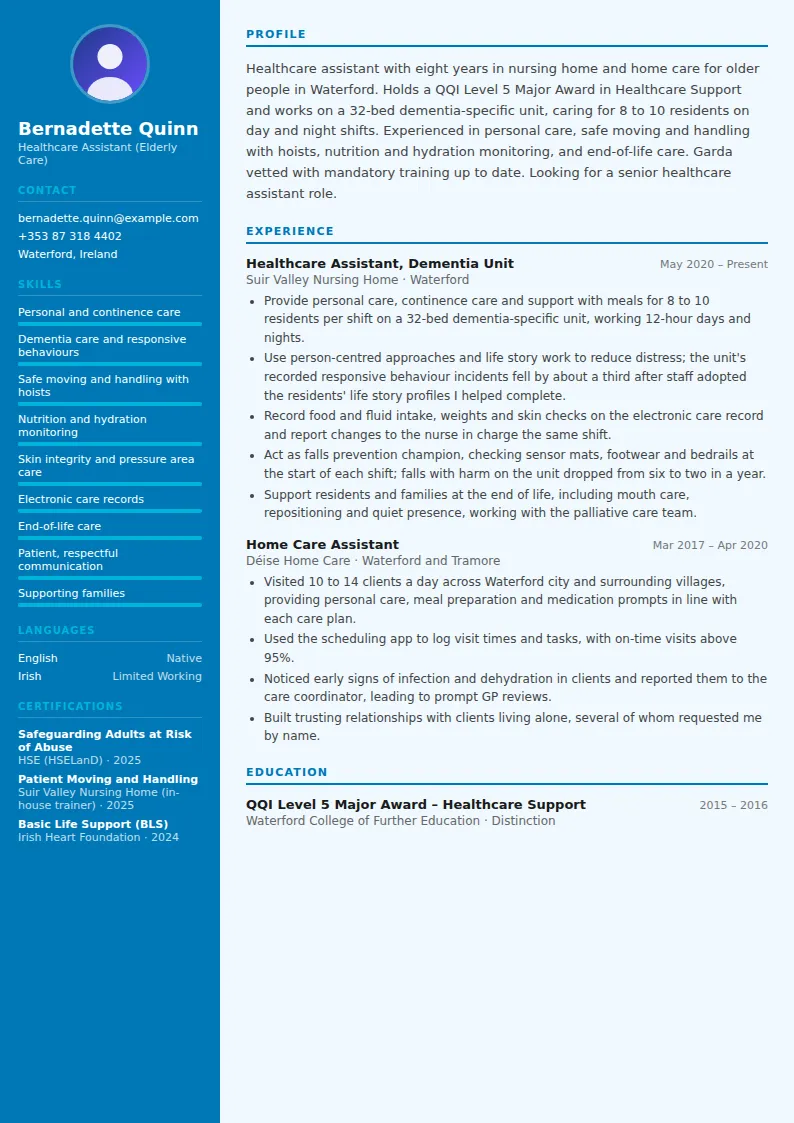
How to write a care assistant CV summary
Your summary should show your setting, your qualification and what care you can give safely. In three or four lines, include:
- Setting: nursing home, residential care, dementia unit, home care, hospital ward, disability service or supported living.
- Qualification: your care qualification and level, or the one you are working towards.
- Experience: years in care, residents or clients per shift, and areas like dementia, palliative care or rehabilitation.
- Practical details: vetting completed, driving licence for home care, shifts you can work.
Phrases like caring and compassionate appear on every care CV. Show it instead with what you do: helps residents with dementia keep their routines using life story work.
Qualifications, vetting and mandatory training
Care employers must check your qualifications and background, so make this information easy to find. Include:
- Care qualification: for example a QQI Level 5 Major Award in Healthcare Support in Ireland, or the Care Certificate and a Level 2 or 3 Diploma in Adult Care in the UK. If you trained abroad, give the original name with a short English description.
- Vetting: say that Garda vetting, a DBS check or your country's equivalent is completed or can be completed. Never include reference numbers or copies on the CV.
- Mandatory training: safeguarding, moving and handling, infection prevention and control, fire safety, basic life support, food hygiene. You can list the key ones with dates or add one line saying all mandatory training is up to date.
- Extra training: dementia care, palliative care, medication administration where permitted, falls prevention, PEG feeding awareness.
Experience: describe the care you give
Managers know the job description, so your bullets should show the setting, the people you care for and how you make a difference. For each role, cover:
- Who and how many: residents or clients per shift, unit size, type of needs such as dementia, stroke, frailty or learning disabilities.
- Care tasks: personal care, continence, moving and handling with hoists and slide sheets, eating and drinking support, skin checks, mouth care.
- Observation and reporting: food and fluid charts, weights, recognising changes and escalating to nurses or care coordinators.
- Quality and safety: falls prevention, infection control, champion or link roles, positive inspection findings.
- Dignity and wellbeing: activities, life story work, supporting families, end-of-life care.
In home care, add the number of visits per day, the area you covered and how you managed your time between calls.
Skills for care work
List practical care skills you are trained and confident in: personal care, continence care, moving and handling with specific equipment, pressure area care, observation charts, nutrition and hydration support, and electronic care records. Name the record system if you know it.
For soft skills, show the ones residents and families notice: patience, gentle communication with people living with dementia, respecting choices and privacy, staying calm in emergencies and working closely with nurses and colleagues. If you speak another language, include it; many care homes and home care services support residents from different backgrounds.
Length, availability and moving into care
One page is enough for most care assistants, two if you have long experience or senior roles. Add a short line about availability, such as days, nights and weekends or part-time mornings, and say whether you drive if you are applying for home care.
If you are new to care, show transferable experience: caring for a family member, volunteering with older people, hospitality or retail work that shows patience and reliability. Many employers will support you through your first care qualification, so say you are willing to train.
Care Assistant CV summary examples
Experienced
Senior care assistant with 12 years in residential and nursing care, leading a team of six care assistants on a 40-bed unit. Holds a Level 3 Diploma in Adult Care, administers medication where trained and authorised, and acts as dementia lead for the home. Supports new staff through their induction and Care Certificate. Looking for a care team leader role.
Mid-level
Home care assistant with four years supporting older people and adults with physical disabilities in their own homes, visiting 10 to 12 clients a day. QQI Level 5 qualified, Garda vetted, with a full driving licence and own car. Experienced in hoist transfers, catheter care and medication prompts. Looking for a full-time role with a home care provider.
Entry-level
Caring and reliable job seeker with two years looking after a grandparent with dementia and volunteer experience at a day centre for older people. Completed basic moving and handling and safeguarding training. Available for day and weekend shifts and keen to complete a care qualification.
Care Assistant CV bullet point examples
- Provided personal care and support with meals for 8 to 10 residents per shift on a 30-bed dementia unit.
- Reduced falls with harm on the unit from five to two in a year as falls prevention champion, checking equipment and footwear every shift.
- Monitored food and fluid intake for residents at risk of malnutrition and escalated weight loss to the nurse in charge.
- Visited 12 to 14 home care clients a day across a rural area, with on-time visits above 95%.
- Used hoists, stand aids and slide sheets safely for residents needing full assistance, with no moving and handling incidents.
- Completed life story profiles for 15 residents, helping colleagues understand routines and reduce distress.
- Supported residents and families during end-of-life care, working with the palliative care team on comfort and dignity.
- Inducted and shadowed six new care assistants during their first two weeks on the unit.
- Organised weekly music and reminiscence sessions, attended by up to 20 residents.
Skills for your Care Assistant CV
Hard skills
- Personal and continence care
- Dementia care
- Safe moving and handling
- Hoist and stand aid use
- Pressure area and skin care
- Nutrition and hydration support
- Observation and charting
- Infection prevention and control
- End-of-life care
- Electronic care records
- Medication prompting or administration where trained
- Basic life support
Soft skills
- Patience and kindness
- Respect for dignity and privacy
- Clear communication with people living with dementia
- Supporting families
- Staying calm in emergencies
- Teamwork with nurses
- Reliability on all shifts