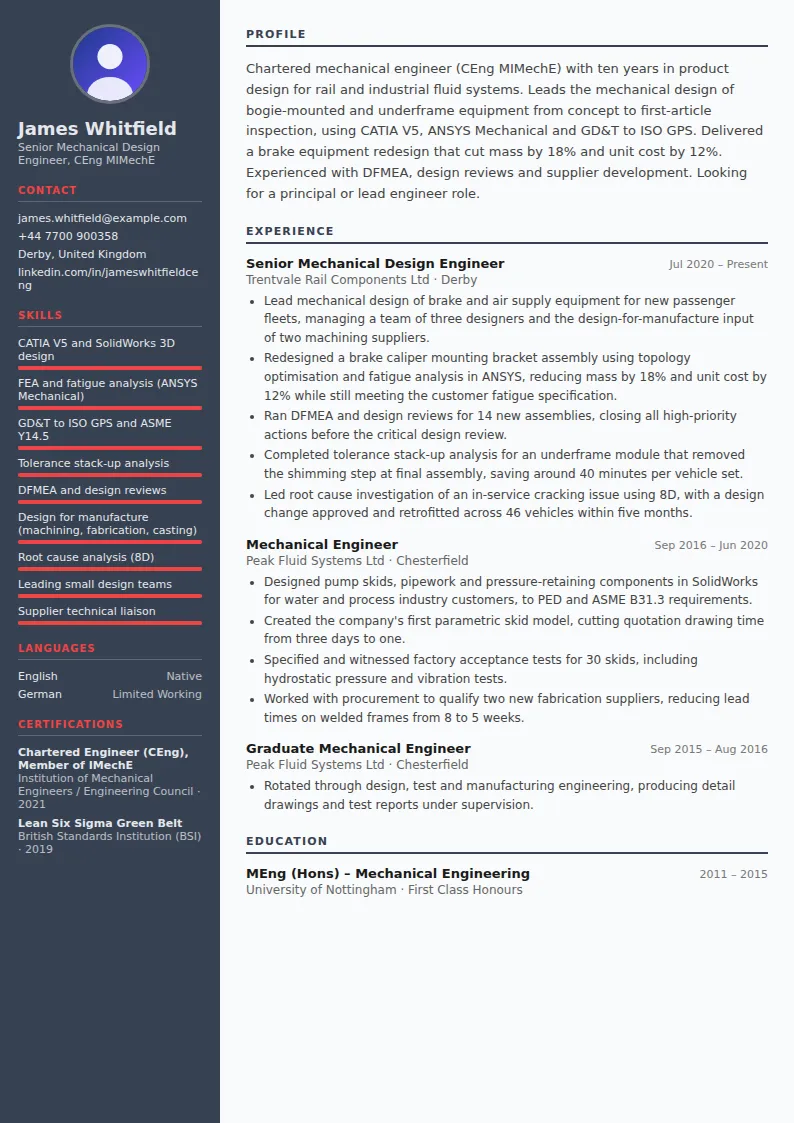
How to write a mechanical engineer CV summary
Your summary should place you within mechanical engineering in three or four sentences. Hiring managers want to know:
- Discipline: design, manufacturing, test and validation, maintenance and reliability, project or application engineering.
- Industry and products: automotive, aerospace, rail, energy, process plant, medical devices, building services or consumer products.
- Tools and methods: your main CAD and analysis software and methods such as GD&T, DFMEA or Lean.
- Status and one result: chartered or incorporated status, or progress towards it, and a measurable outcome.
A summary like Design engineer with six years in automotive seating, expert in CATIA V5 and tolerance analysis, working towards CEng gives a recruiter a precise match.
Experience: technical detail plus outcomes
Engineering bullets need enough technical detail to be credible and a result that shows why it mattered. For each role, describe the products and your responsibility, then choose three to five bullets covering:
- Design work: what you designed, the materials and processes, the standards and load cases.
- Analysis and test: FEA, CFD, hand calculations, prototype tests, test rigs, and how results changed the design.
- Outcomes: mass, cost, part count, reliability, energy use, lead time, scrap rate or warranty claims.
- Process: design reviews, DFMEA, change control, first-article inspection, PPAP or APQP in automotive.
- People: leading designers, working with suppliers, customers or production teams.
Be accurate about your role on team projects. Designed the gearbox housing and supported the gearbox team are different claims, and interviewers will probe them.
Software, standards and technical skills
Recruiters and applicant tracking systems search for software by name, so list exactly what you use and at what level:
- CAD: SolidWorks, CATIA, Siemens NX, Creo, Inventor, and PDM or PLM systems such as Windchill or Teamcenter.
- Analysis: ANSYS, Abaqus, SolidWorks Simulation, CFD tools, MATLAB or Python for calculations.
- Drawing and tolerancing: GD&T to ASME Y14.5 or ISO GPS, tolerance stack-ups, technical drawing standards.
- Standards: the design or industry standards you work to, such as pressure equipment rules, Eurocodes for structures, railway standards or medical device quality standards.
Group them in a technical skills section and back up the most important ones with bullets in your experience.
Chartership, registration and education
Professional registration matters in many engineering jobs, especially at senior level. If you hold it, put it next to your name or in the summary, for example CEng MIMechE or IEng in the UK, Chartered Engineer with Engineers Ireland, or EUR ING through FEANI. If you are working towards it, say so: working towards CEng, IMechE mentored scheme.
List your degree with the class or grade, and include a final-year project if you are early in your career and it is relevant. Short courses such as GD&T, Six Sigma, project management or a specific CAD certification can go under certifications.
Length, tailoring and moving between industries
Two pages suit most mechanical engineers. Graduates can use one page with projects, placements and a strong education section. Keep older roles brief unless they are directly relevant to the job.
Tailor your CV to the industry and discipline in the advert. A design role in aerospace wants CAD, stress analysis and certification experience; a manufacturing role in automotive wants process improvement, PPAP and production support; a maintenance role wants reliability, root cause analysis and safety. If you are changing industry, show the transferable methods and say which standards you are learning.
Mechanical Engineer CV summary examples
Experienced
Principal mechanical engineer and CEng with 16 years in aerospace structures and mechanisms, leading a team of nine on landing gear and actuation projects. Responsible for design authority sign-off, certification evidence and supplier technical reviews. Delivered a weight reduction programme that saved 14 kg per aircraft set. Looking for an engineering manager role.
Mid-level
Manufacturing engineer with five years in automotive components, supporting machining and assembly lines producing 1.2 million parts a year. Experienced in PFMEA, PPAP, Lean and root cause analysis, with SolidWorks for fixture design. Cut scrap on a key line from 3.1% to 1.4%. Working towards IEng. Looking for a senior manufacturing engineer role.
Entry-level
MEng Mechanical Engineering graduate with a 12-month industrial placement in a pump manufacturer's design team, where I produced SolidWorks models, drawings and FEA checks for impeller housings. Final-year project on composite bracket design using topology optimisation. Looking for a graduate design engineering role.
Mechanical Engineer CV bullet point examples
- Redesigned a cast aluminium housing as a machined assembly, cutting tooling lead time from 16 to 6 weeks and unit cost by 9%.
- Ran FEA and fatigue analysis on a chassis bracket, identifying a stress concentration that would have failed the durability test.
- Reduced part count on a valve assembly from 27 to 19 parts through design for assembly, saving 6 minutes of assembly time per unit.
- Led DFMEA sessions for a new product platform with design, quality and manufacturing teams, closing 42 high-risk actions before launch.
- Specified and commissioned a test rig for 1 million-cycle fatigue tests, cutting reliance on external test houses.
- Completed tolerance stack-ups for a gearbox assembly that eliminated a selective-fit step on the production line.
- Investigated warranty failures using 8D and introduced a material change that reduced returns by 60% within a year.
- Developed parametric CAD models for a product family, reducing drawing time for custom orders by two-thirds.
- Supported first-article inspection and PPAP submissions for 15 new parts across three suppliers.
Skills for your Mechanical Engineer CV
Hard skills
- 3D CAD: SolidWorks, CATIA, NX or Creo
- FEA and structural analysis
- GD&T and technical drawings
- Tolerance stack-up analysis
- DFMEA and PFMEA
- Design for manufacture and assembly
- Material selection
- Prototype testing and validation
- Root cause analysis (8D, 5 Whys)
- PDM/PLM systems
- Engineering change control
- Engineering calculations in MATLAB or Python
Soft skills
- Clear technical communication
- Working with suppliers and production
- Structured problem-solving
- Leading design reviews
- Mentoring graduate engineers
- Balancing cost, quality and time
- Attention to detail