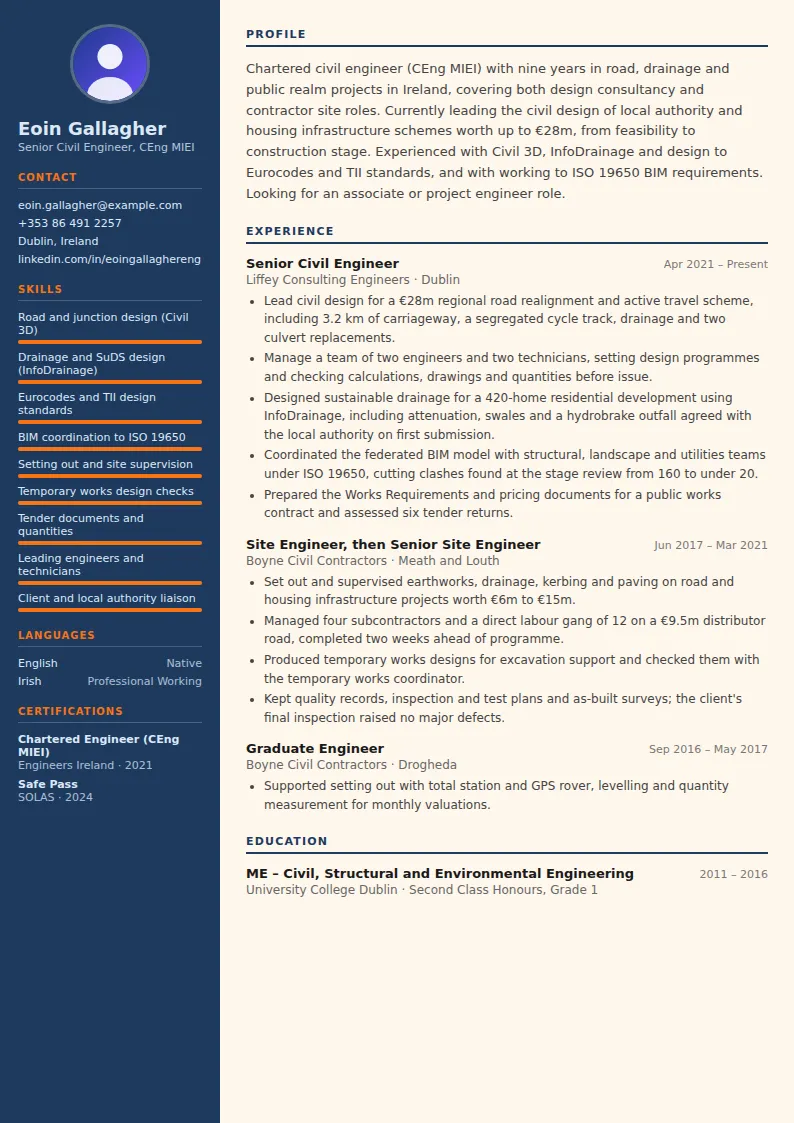
How to write a civil engineer CV summary
Your summary should match you to the right team in three or four sentences. Include:
- Sector: highways, water and wastewater, drainage and flood risk, bridges and structures, rail, geotechnics, ports or buildings.
- Role type: consultancy design, contractor site engineering, client-side or public body, or a mix.
- Scale: typical project values and the stages you cover, from feasibility and design to construction and handover.
- Status and tools: chartered or incorporated status and the main software and standards you use.
End with your next step. A recruiter matching you to a senior drainage engineer, consultancy role should see the match in your first two lines.
Describe projects by value, scope and your role
Civil engineering is project-based, so your experience should read like a project record. For each role, give the main projects with:
- Project and client type: local authority road scheme, water utility upgrade, residential infrastructure, rail station, private developer.
- Value and scope: contract value, length of road or pipe, number of homes or structures, catchment size.
- Your role: lead designer, design checker, site engineer, section engineer, project engineer, resident engineer.
- What you did and achieved: designs completed, approvals gained first time, programme or cost savings, problems solved on site.
- Safety and quality: incident-free hours, inspection results, temporary works managed.
Senior engineers with many projects can add a short project list at the end of the CV, with one line per project: name or description, value, dates and role.
Chartership, standards and software
Professional status is a major factor at senior level. Show it after your name or in your summary, such as CEng MIEI in Ireland or CEng MICE in the UK, and if you are working towards it, say which stage you are at, for example on an ICE Initial Professional Development scheme.
Then list your technical tools and standards:
- Design software: AutoCAD Civil 3D, OpenRoads, InfoDrainage or MicroDrainage, Flood Modeller or HEC-RAS, Tekla, Revit, structural analysis tools.
- Standards: Eurocodes, national road and drainage standards (such as TII in Ireland or the DMRB in the UK), and water or rail industry specifications.
- BIM and data: ISO 19650 processes, common data environments, Navisworks for clash detection.
- Site tools: total stations, GPS rovers, levelling, setting-out software.
Site experience, safety and contracts
Site experience is valued even for design roles, because it shows you understand buildability. Describe the works you supervised, the subcontractors and teams you managed, the temporary works you were involved in and your record on safety.
List safety and site training such as Safe Pass in Ireland or a CSCS card in the UK, temporary works coordinator or supervisor training, and first aid. Mention the contract forms you have worked with, such as NEC, FIDIC or Irish public works contracts, in terms of what you actually did: early warnings, compensation events, valuations or tender assessment.
Length, graduates and tailoring
Two pages suit most civil engineers, with an optional project list for senior roles. Graduates can use one or two pages, leading with their degree, final-year project, placements and any site or summer work.
Before applying, check whether the role is design or site, which sector it is in and which software and standards it names. Move your most similar projects to the top and mirror the language of the advert where it is accurate. If you are moving from contractor to consultancy, or the reverse, show the skills that carry over: buildability and programme knowledge from site, or design and approvals experience from consultancy.
Civil Engineer CV summary examples
Experienced
Chartered civil engineer (CEng MICE) and associate director with 18 years in water and wastewater infrastructure, leading a team of 25 engineers on treatment works and network upgrades worth up to £90m. Responsible for design delivery, fee budgets and client relationships with two water utilities. Looking for a director role in a water consultancy.
Mid-level
Site engineer with six years on highways and bridge projects, setting out, supervising structures and managing subcontractors on schemes worth €10m to €40m. Experienced with NEC contracts, temporary works and quality records. Working towards chartered status. Looking for a section engineer role on a major road or rail project.
Entry-level
Civil engineering graduate (MEng) with a summer placement on a residential infrastructure site and a final-year project on sustainable drainage design. Confident with AutoCAD Civil 3D, levelling and basic hydraulic calculations. Looking for a graduate engineer position on a structured professional development scheme.
Civil Engineer CV bullet point examples
- Designed 4.5 km of foul and surface water sewers for a 600-home development, approved by the water utility without changes at first submission.
- Supervised construction of a three-span bridge worth €6.8m, coordinating piling, deck pours and parapet installation with no lost-time incidents.
- Value-engineered a retaining wall from reinforced concrete to a gabion solution, saving €340,000 while meeting the design life.
- Led the flood risk assessment and hydraulic modelling for a town centre regeneration scheme, securing planning approval.
- Managed six subcontractors and a site team of 20 on a €12m road scheme, completing three weeks early.
- Checked and approved 35 temporary works designs as temporary works coordinator on a busy urban site.
- Reduced design clashes by 85% before tender by leading weekly federated model reviews in Navisworks.
- Prepared monthly valuations and assessed compensation events under NEC, keeping the final account within 2% of forecast.
- Mentored four graduate engineers through their professional development records, with two reaching chartered status.
Skills for your Civil Engineer CV
Hard skills
- Highway and junction design
- Drainage, SuDS and flood risk assessment
- Hydraulic modelling
- Structural design to Eurocodes
- AutoCAD Civil 3D or OpenRoads
- BIM to ISO 19650 and Navisworks
- Setting out and surveying
- Temporary works design and coordination
- Quantities, valuations and cost control
- Contract administration (NEC, FIDIC, public works)
- Quality plans and inspection records
- Planning and statutory approvals
Soft skills
- Leading site teams and subcontractors
- Client and authority liaison
- Clear technical reports
- Problem-solving on site
- Safety leadership
- Mentoring graduates
- Managing competing deadlines