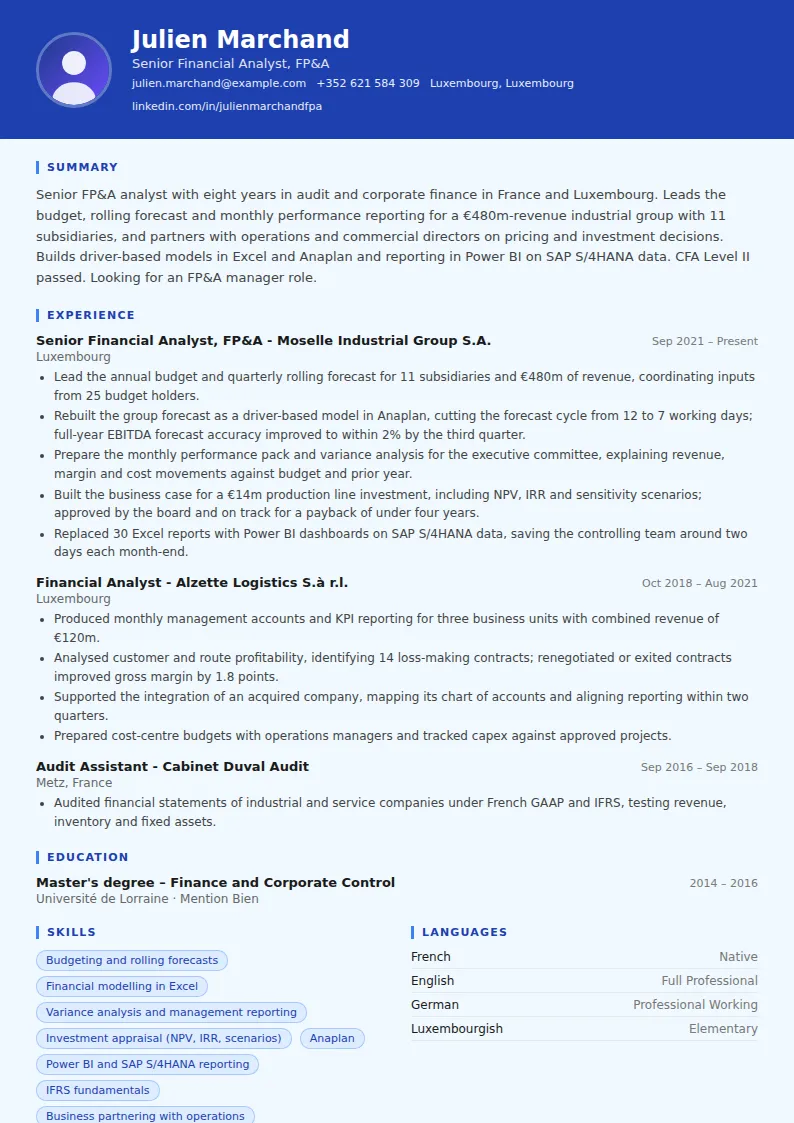
How to write a financial analyst CV summary
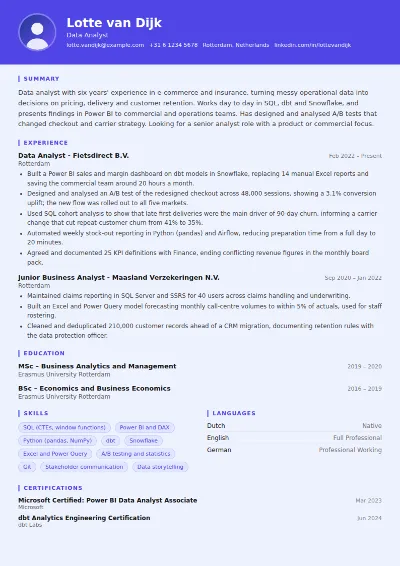
Your summary should show the kind of analysis you do and the scale you work at. In three or four sentences, include:
- Type of role: FP&A, business or commercial finance, investment analysis, credit, equity research, treasury or corporate development.
- Scope: the revenue, portfolio, entities or business units you cover, and your stakeholders.
- Core processes and tools: budgeting, forecasting, month-end reporting, business cases, valuation; Excel, ERP and planning or BI tools.
- Qualifications and next step: CFA, ACCA, CIMA or progress towards them, and the role you want.
Replace generic lines like analytical and detail-oriented with a concrete achievement, such as improving forecast accuracy or a business case that was approved.
Experience: show impact, not just reports
Many analyst CVs list reports produced. Hiring managers want to know what those reports led to. For each role, describe the scope and then choose bullets that show:
- Planning: budgets and forecasts you led, number of entities or budget holders, cycle time, forecast accuracy.
- Insight: variance analysis that explained performance, profitability analysis that led to pricing or cost decisions.
- Decisions: business cases, investment appraisals or valuations, with their size and outcome.
- Efficiency: automation, new models or dashboards that saved time or reduced errors.
- Projects: system implementations, acquisitions, integrations or restructurings you supported.
Give amounts and percentages wherever you can, but respect confidentiality. Rounded figures or ranges are fine when exact numbers are sensitive.
Modelling, systems and technical skills
Technical skills are often tested in finance interviews, so describe them accurately:
- Excel and modelling: three-statement models, driver-based forecasts, DCF and scenario analysis, and advanced functions or Power Query.
- ERP and planning tools: SAP, Oracle, Microsoft Dynamics, Anaplan, Adaptive Planning, Board or similar.
- BI and data: Power BI, Tableau, SQL or Python for analysis.
- Accounting knowledge: IFRS or local GAAP, consolidation, cost accounting.
Name the tools you use and say what you built with them. Built a driver-based forecast model in Anaplan is more convincing than proficient in planning software.
Qualifications and education
List your degree with the institution and grade, then professional qualifications with their status. For CFA, say which levels you have passed and when; for ACCA or CIMA, give the number of papers completed or your expected qualification date. Employers value progress, so include qualifications in progress with an honest status.
If your degree or qualifications come from another country, use the original name with a short English description, as with a French master's or a German diploma. Short courses in financial modelling, data analysis or specific systems can go in a certifications section if they support the role.
Length, tailoring and moving into finance
One page suits graduates and junior analysts, especially for investment banking and asset management, where one-page CVs are common. Two pages suit experienced FP&A and business finance analysts.
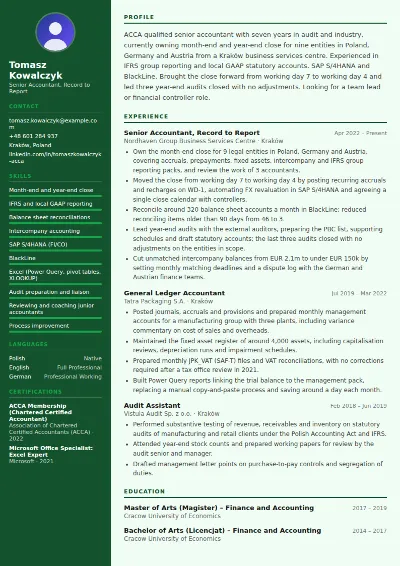
Tailor your CV to the type of finance role. Corporate FP&A roles want planning, business partnering and systems. Investment and equity roles want valuation, sector knowledge and market awareness. Credit roles want financial statement analysis and risk assessment. If you are moving from audit or accounting into analysis, highlight the analytical parts of your work, such as reviewing forecasts, testing valuations or preparing management reports.
Financial Analyst CV summary examples
Experienced
FP&A manager with 12 years in consumer goods and retail, leading a team of five analysts supporting a €1.2bn business across eight countries. Owns the group budget, long-range plan and board reporting, and introduced a rolling forecast in Anaplan that improved accuracy and shortened the cycle by a week. CIMA qualified. Looking for a head of FP&A role.
Mid-level
Financial analyst with four years in business finance at a software company, partnering with sales and marketing leaders on a €90m budget. Builds subscription revenue forecasts, pricing analysis and investment cases, with reporting in Power BI. ACCA part-qualified with eight papers passed. Looking for a senior FP&A analyst role.
Entry-level
Economics and finance graduate with a six-month internship in an FP&A team, where I prepared variance analysis, updated forecast models and built a Power BI sales dashboard. Strong Excel and modelling skills from a financial modelling course and university projects. CFA Level I candidate. Looking for a graduate financial analyst role.
Financial Analyst CV bullet point examples
- Led the annual budget for a €300m business with 40 cost centres, delivering the board pack on schedule for three consecutive years.
- Improved full-year forecast accuracy from within 6% to within 2% by introducing driver-based forecasting for revenue and labour costs.
- Built a pricing analysis showing margin erosion on 20% of SKUs, leading to price increases that added €2.1m in annual gross profit.
- Prepared the business case for a €9m warehouse automation project, including NPV, IRR and downside scenarios; approved and delivered within budget.
- Automated monthly management reporting with Power Query and Power BI, cutting month-end reporting time by three days.
- Analysed customer profitability across 600 accounts, identifying unprofitable contracts that were renegotiated to improve margin by 1.5 points.
- Supported due diligence and integration for two acquisitions, building the combined forecast and aligning charts of accounts.
- Presented monthly variance commentary to the executive committee, focusing on actions rather than explanations.
- Built a three-statement model for a refinancing, used by the treasurer in negotiations with three banks.
Skills for your Financial Analyst CV
Hard skills
- Budgeting and forecasting
- Financial modelling (three-statement, DCF)
- Variance analysis
- Management reporting and KPIs
- Business cases and investment appraisal
- Advanced Excel and Power Query
- ERP systems such as SAP or Oracle
- Planning tools such as Anaplan or Adaptive
- Power BI or Tableau
- SQL for financial data
- IFRS and consolidation basics
- Cost and profitability analysis
Soft skills
- Business partnering
- Clear presentation of numbers
- Influencing decisions
- Attention to detail
- Working to month-end deadlines
- Curiosity and problem-solving
- Discretion with sensitive data