Put your cards and tickets first
Most sites will not let you start without the right cards, so put them near the top of your CV, either in the summary or in a short section of their own. For each one, give the card or ticket name and its expiry date:
- Site safety card: in the UK, your CSCS card and its colour (green labourer, blue skilled worker, gold supervisor); in Ireland, Safe Pass and any CSCS cards; elsewhere, your national equivalent.
- Plant tickets: dumper, roller, excavator, telehandler and others, with the scheme name such as CPCS or NPORS and whether you hold a red trained or blue competent card.
- Access equipment: PASMA for mobile towers, IPAF for powered access.
- Safety training: asbestos awareness, abrasive wheels, working at height, confined spaces, first aid, SSSTS or SMSTS for supervisors.
If a card is expiring soon, say when your renewal is booked. Agencies often reject CVs with out-of-date cards before calling.
How to write a construction worker CV summary
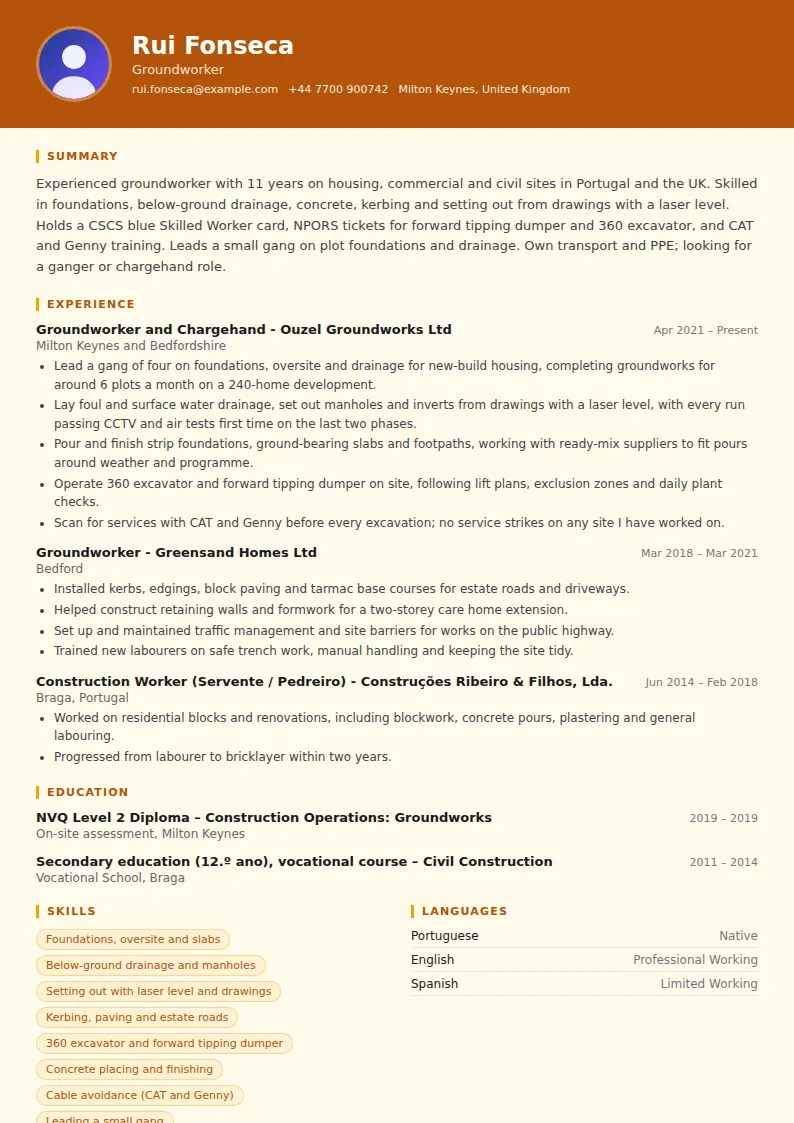
Three or four lines are enough. Say your trade or main type of work, how many years you have done it, the sites you know and your key cards. For example: Groundworker with eight years on housing and commercial sites, CSCS blue card, NPORS dumper and roller, experienced in drainage, foundations and kerbing.
Add practical extras that site managers care about: own transport, own PPE and hand tools, willingness to travel or stay away, and the role you want next, such as chargehand, ganger or a move into a new trade.
Experience: describe the work, sites and results
For each job, give the type of site and the company, then three to five bullets about what you built or did. Useful details include:
- Type of work: foundations, drainage, concrete, formwork, blockwork, steel fixing, kerbing, paving, demolition, general labouring.
- Site and scale: number of homes on the development, size of the commercial building, length of road or drainage run.
- Quality and speed: plots completed per week or month, tests passed first time, work signed off without snagging.
- Safety: no accidents or service strikes, following permits and method statements, toolbox talks you delivered.
- Responsibility: leading a gang, training new starters, ordering materials, reading drawings and setting out.
Agency work and short contracts are normal in construction. You can group them under one heading with the main sites and dates, so your CV doesn't become a long list.
Skills to put on a construction CV
List the practical skills you can show on day one: reading drawings, setting out with a laser or dumpy level, using plant you hold tickets for, mixing and placing concrete, laying pipes to falls, cutting with disc cutters if you hold abrasive wheels training, and using hand and power tools safely.
For soft skills, choose what matters on site: following instructions and method statements, working safely when under time pressure, communicating with other trades, reliability in all weather, and leading or supporting a small team. If English is not your first language, list your level honestly, because site managers need to know you will understand inductions and safety briefings.
Length, format and moving up on site
One page is enough for most construction workers, two for supervisors with many tickets and projects. Keep the format plain with your phone number and location at the top. Many site managers and agencies will call you straight away if your tickets match the job.
If you want to move up to chargehand, ganger or supervisor, add evidence of leadership: running a gang, organising materials, checking work against drawings and delivering toolbox talks. A supervisor course such as SSSTS, and a gold supervisor card in the UK, will help you make that move.
Construction Worker CV summary examples
Experienced
Groundworks supervisor with 16 years on housing and commercial projects, running teams of up to 15 across multiple plots and subcontractors. SMSTS and CSCS gold card holder with CPCS excavator and dumper tickets. Delivered groundworks for a 320-home development on programme. Looking for a site supervisor or assistant site manager role.
Mid-level
Construction worker with five years on commercial and refurbishment sites, experienced in concrete, formwork, blockwork support and general labouring. CSCS green card, PASMA, asbestos awareness and abrasive wheels. Own transport and PPE, and happy to work away. Looking for a permanent role and training towards an NVQ Level 2.
Entry-level
Fit and reliable school leaver with a CSCS green labourer card and Level 1 Health and Safety in a Construction Environment. Experience helping on family building jobs with mixing, carrying materials and clearing sites. Looking for a labourer role or construction apprenticeship.
Construction Worker CV bullet point examples
- Completed foundations and drainage for around 6 plots a month on a 240-home housing development, keeping pace with the bricklaying programme.
- Laid 1.2 km of foul and surface water drainage with every run passing CCTV and air tests first time.
- Installed 900 metres of kerbs and edgings for estate roads, with no rework needed at highway authority inspection.
- Operated a forward tipping dumper and 360 excavator daily, completing pre-use checks and working within exclusion zones.
- Scanned for buried services with CAT and Genny before every dig, with no service strikes in five years.
- Led a gang of four on a commercial slab pour of 180 m³, finished within the day despite a delayed pump.
- Built formwork and fixed steel for retaining walls and foundations on a care home extension.
- Delivered weekly toolbox talks on trench safety and manual handling for a team of 10.
- Set up traffic management and pedestrian routes for works on a busy public road with no incidents.
Skills for your Construction Worker CV
Hard skills
- Groundworks and excavation
- Below-ground drainage
- Foundations and concrete slabs
- Formwork and steel fixing
- Kerbing and block paving
- Setting out with laser levels
- Reading construction drawings
- Plant operation (dumper, roller, excavator)
- Cable avoidance tools
- Traffic management set-up
- Hand and power tools
- Site safety procedures and permits
Soft skills
- Working safely under time pressure
- Following method statements
- Reliability in all weather
- Teamwork with other trades
- Leading a small gang
- Clear communication on site
- Willingness to learn new skills