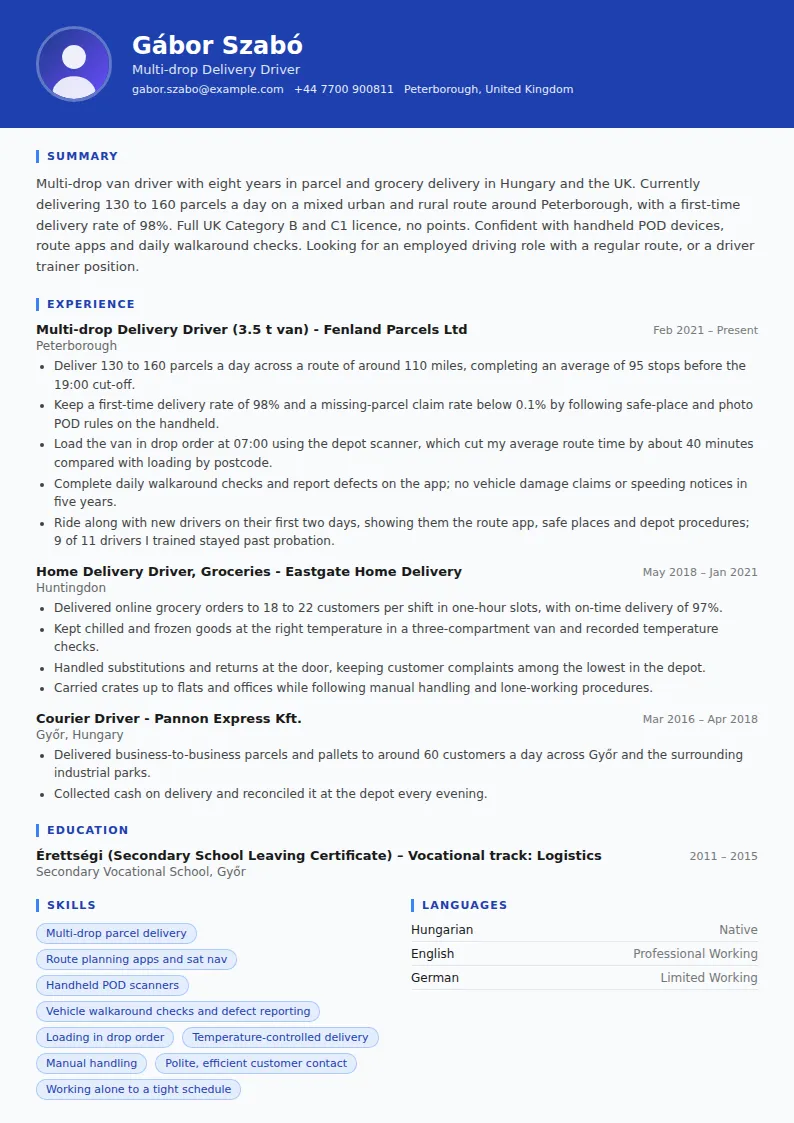
Put your licence details at the top
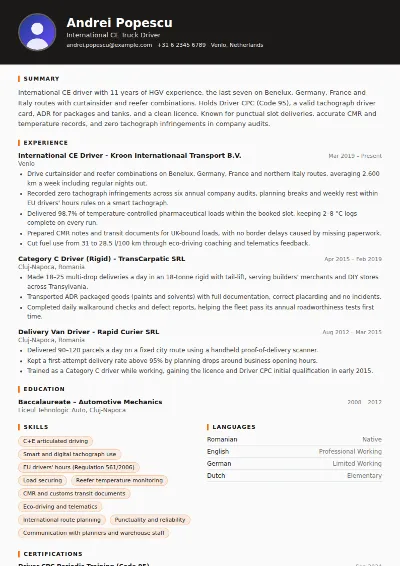
Your driving licence is the first thing a delivery employer checks, so put it in your summary or directly under your name. Include:
- Categories: Category B for vans up to 3.5 tonnes; C1 for vehicles up to 7.5 tonnes; B+E if you tow trailers.
- How long you have held it: many insurers and companies require a minimum period, often two or three years.
- Penalty points: say clean licence or state the number of points honestly. Employers check it anyway.
- Extras: a Driver CPC if you drive C1 or larger vehicles for work, or a digital tachograph card if you have one.
If you have moved countries, say whether you have exchanged your licence for a local one or still drive on your original licence.
How to write a delivery driver CV summary
In three or four lines, your summary should cover your licence, the type of delivery work you know, your daily volume and one sign of quality. For example: Category B van driver with five years in parcel delivery, completing 120+ drops a day with a 97% first-time delivery rate and a clean licence.
Also say what you are looking for: employed or self-employed work, a fixed route, nights or early starts, or a move to larger vehicles. Delivery companies have very different set-ups, and a clear goal helps them place you quickly.
Experience: drops, routes and reliability
Delivery companies track drivers with simple, measurable figures. Use them in your bullets:
- Volume: parcels or stops per day, drops per shift, miles or kilometres covered.
- Quality: first-time delivery rate, on-time rate for delivery slots, missing-parcel or damage claims, customer feedback.
- Type of goods: small parcels, groceries with temperature control, two-person furniture or white goods, pharmacy, building materials, cash on delivery.
- Safety: no accidents or damage, telematics driving scores, completed walkaround checks.
- Extras: loading the van, route planning, collections and returns, training new drivers.
A recruiter learns more from 98% first-time delivery on a 150-parcel rural route than from good time management.
Skills and training for van drivers
List practical skills a delivery manager can use: handheld POD devices and route apps, loading in drop order, vehicle checks and defect reporting, safe manual handling, temperature control for chilled goods, and knowledge of the local area. If you have done two-person deliveries, mention installation or assembly tasks too.
Training worth listing includes defensive or safe urban driving courses, manual handling, first aid and any customer service or dangerous goods awareness training. For soft skills, focus on working alone to a schedule, staying polite with customers at the door and solving problems such as access codes, missing addresses or refused parcels.
Length, format and self-employed work
One page is enough for most delivery drivers. Use clear headings and put your licence, availability and location on the first lines; many depots hire people who live within a short drive.
If you have worked self-employed for a parcel network or as an owner-driver, describe it like any other job: who you delivered for, the route and the volume. Say whether you used your own van or a rented one, and whether you are open to employed or self-employed roles in future.
Delivery Driver CV summary examples
Experienced
Delivery driver and driver trainer with 12 years in parcel and two-person furniture delivery, holding Category B and C1 licences with no points. Trains new drivers on routes, loading and customer service, and keeps a telematics driving score in the top 10% of the depot. Looking for a transport supervisor or driver trainer role.
Mid-level
Van driver with four years delivering pharmacy and healthcare supplies to care homes, surgeries and patients' homes on timed routes. Category B licence held for eight years, no points. On-time delivery above 98% and a careful approach to signatures and controlled deliveries. Looking for a regular day route with an employer.
Entry-level
Full Category B licence holder for three years with no points, looking for a first delivery driver role. Experienced in fast-paced work from a year in a supermarket warehouse, used to handheld scanners and heavy lifting. Knows the local area well and is available for early starts and weekends.
Delivery Driver CV bullet point examples
- Delivered 140 to 170 parcels a day on a mixed urban and rural route, keeping a 98% first-time delivery rate.
- Completed 20 to 25 timed grocery deliveries per shift with 97% on time and correct temperature records for every chilled order.
- Kept a clean licence and no vehicle damage claims across five years and more than 120,000 miles of delivery driving.
- Loaded the van in drop order every morning, reducing average route time by 30 to 40 minutes.
- Made two-person deliveries of furniture and white goods to 12 to 15 homes a day, including unpacking and removing packaging.
- Achieved a telematics driving score of 96, among the top five in a depot of 60 drivers.
- Handled collections and returns for around 25 business customers a day alongside a full delivery route.
- Trained eight new drivers on the route app, safe-place rules and depot procedures during their first week.
- Delivered prescriptions and medical supplies to around 70 patients a day, following signature and ID check procedures.
Skills for your Delivery Driver CV
Hard skills
- Category B van driving
- Category C1 (7.5 t) driving
- Multi-drop parcel delivery
- Route planning and navigation apps
- Handheld POD devices
- Loading in drop order
- Daily walkaround checks
- Temperature-controlled delivery
- Two-person furniture and white goods delivery
- Collections and returns
- Cash on delivery handling
- Safe manual handling
Soft skills
- Working alone to a schedule
- Polite customer contact at the door
- Problem-solving on the road
- Reliability and punctuality
- Calm driving in heavy traffic
- Honesty with parcels and payments
- Flexibility for peak periods